Scale delivery efficiency using Adloggs' AI-powered orchestration for unified, intelligent last-mile logistics
28 September, 2026


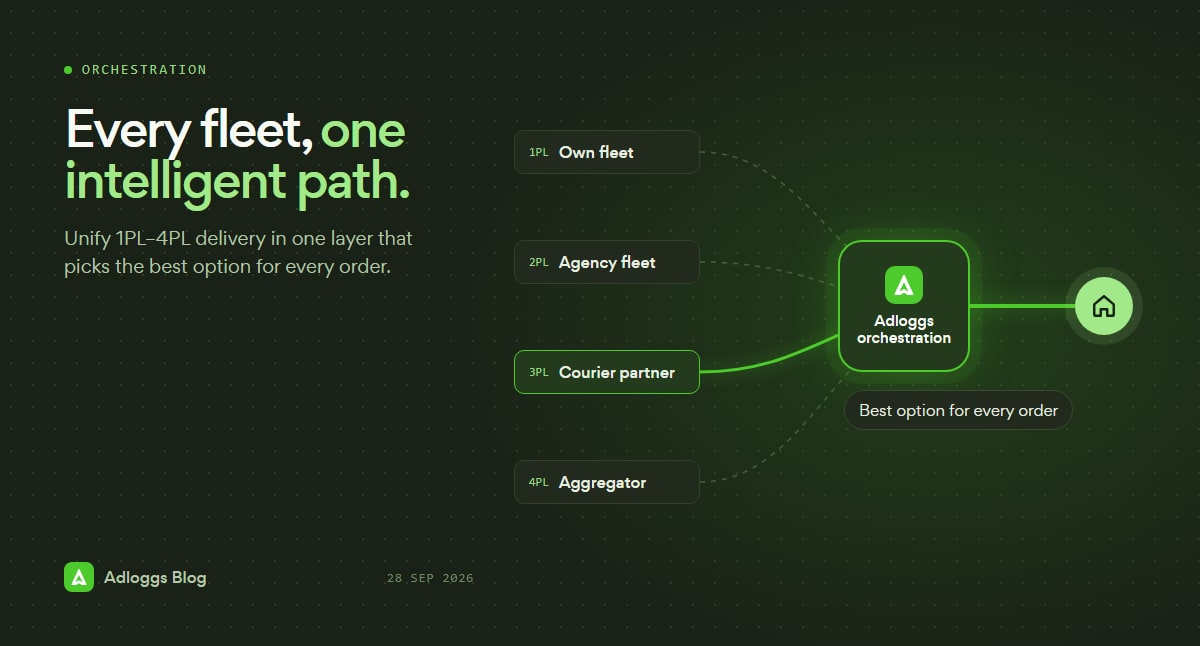
Most delivery operations don't have a capacity problem. They have a fragmentation problem: riders in one app, partners in five portals, customers on WhatsApp and the truth in a spreadsheet.
Walk into most delivery operations and you’ll find the same picture: own riders in one app, each 3PL partner in its own portal, exceptions handled in WhatsApp groups, and performance reviewed in a spreadsheet at the end of the week. Nobody can answer a simple question in real time: for this order, right now, who is the best option?
That gap is expensive. The last mile already accounts for 41% of overall supply-chain costs (Capgemini). When cost and performance data is scattered, allocation falls back on habit, and habit is rarely the cheapest or the fastest choice.
Orchestration replaces the patchwork with one decision layer that every order passes through:
Demand and supply are both growing. India’s quick commerce market is forecast to reach US$12.97 billion by 2029 at 17.6% a year, and NITI Aayog projects 23.5 million gig and platform workers by 2029–30. More partners and riders are available than ever; orchestration is what turns that supply into reliable, affordable delivery.
With the October–November festive peak ahead, five steps pay off immediately:
Efficiency at scale comes from unification, not from more portals or more people. The Adloggs delivery orchestration system, powered by its agentic AI suite, gives every order one intelligent path from intake to doorstep.
It is a single control layer that takes orders from every channel and decides, for each one, which fleet or partner delivers it, which route it takes and how it is monitored and communicated, using live data across own fleets and 1PL–4PL partners.
A delivery management system runs deliveries; orchestration coordinates many fleets and partners through one decision layer. Adloggs combines both: its DMS manages orders and riders, and its orchestration layer allocates across every connected partner.
Adloggs Dispatch is zero-touch dispatch for merchants. A browser extension captures orders from the ordering sites a merchant already uses, and the Dispatch App books a rider on Rapido, Porter or the Adloggs 3PL network automatically, with timed fallback between partners.
Examples marked as illustrative show typical scenarios, not results from a specific customer.
Adloggs is an AI-powered delivery Operating System for India and beyond, offering smart delivery orchestration, AI-driven routing, partner aggregation, and hyperlocal logistics for enterprises, QSRs, grocery, pharmacy, restaurant, and ecommerce brands.
Adloggs Technologies Private Limited,
Sri krishna towers, Thirumurugan Nagar Road, Periyar Nagar, Nehru Nagar West, Coimbatore, Tamil Nadu 641048.
© 2026 - 2027 Adloggs All Right Reserved