Scale delivery efficiency using Adloggs' AI-powered orchestration for unified, intelligent last-mile logistics
28 September, 2026


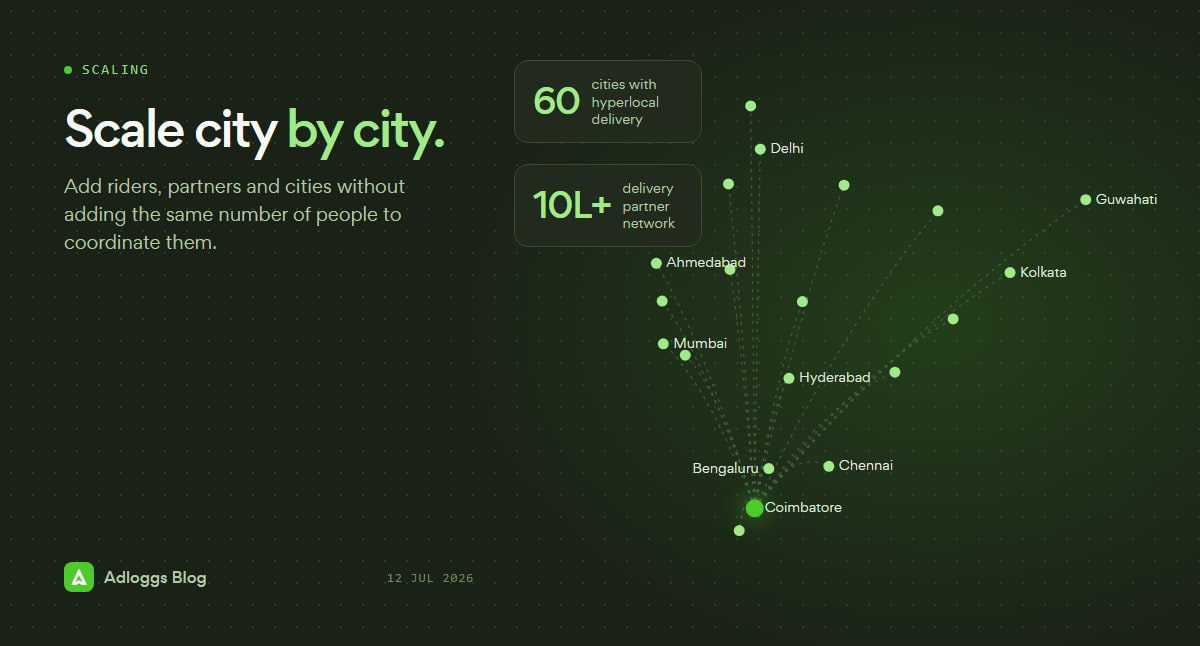
Growth is where delivery operations break. A new city, a new partner or a doubled order volume exposes every manual step that worked fine at a smaller size.
At small volume, a good dispatcher and a WhatsApp group can run delivery. Growth changes three things at once: more orders per hour, more riders and partners to coordinate, and more places to serve. Each one adds decisions; together they multiply them.
The market isn’t waiting. India’s quick commerce market is forecast to reach US$12.97 billion by 2029, growing 17.6% a year. The rider workforce is growing too: NITI Aayog projects 23.5 million gig and platform workers by 2029–30, up from 7.7 million in 2020–21. Capacity is out there. The hard part is coordinating it without costs running away in a last mile that already takes 41% of supply-chain costs (Capgemini).
Owning every rider in every city is slow and expensive. Adloggs connects your own fleet with 1PL, 2PL, 3PL and 4PL partners through its 10 lakh+ delivery partner network, so new demand can be served before you hire for it. See the partner ecosystem.
Every new city needs new riders, and every new rider is a trust decision. VerifyOS automates onboarding with facial recognition, ID matching, liveness checks, document validation and compliance scoring.
More orders should make routes more efficient, not more chaotic. Routa plans for speed, batching, fuel efficiency, rider capacity and geo-clusters, so higher volume turns into more drops per trip.
With several fleets in play, LoggiAI decides who delivers each order, weighing demand, partner performance, rider availability, traffic and cost in real time.
ControlX watches all cities and all partners in one place, predicting disruptions and acting before SLAs break, so a new city doesn’t need its own war room.
Order volume shouldn’t mean support volume. Zoya answers order questions on WhatsApp with 99% accuracy, and Vox handles delivery calls and escalations by voice.
Adloggs already runs hyperlocal delivery across 60 Indian cities, and each city page shows how delivery works locally.
Seamless scaling isn’t about working harder at the dispatch desk; it’s about building each layer once and letting it run everywhere. That is what the Adloggs delivery management system and its agentic AI suite provide.
Coordination. Each new city, partner or peak adds decisions about capacity, routing and exceptions. When those decisions are made by hand, headcount has to grow with volume, and quality drops during the transition.
Smart routing plans routes around live conditions and constraints: batching nearby orders, grouping stops by geo-cluster, respecting rider capacity and reducing distance and fuel. Adloggs' Routa agent does this for hyperlocal, multi-stop and large-fleet delivery.
Adloggs connects your own riders with 1PL–4PL partners through a 10 lakh+ delivery partner network, verifies new riders with VerifyOS, plans routes with Routa, allocates orders with LoggiAI and monitors SLAs with ControlX from the first day.
Examples marked as illustrative show typical scenarios, not results from a specific customer.
Adloggs is an AI-powered delivery Operating System for India and beyond, offering smart delivery orchestration, AI-driven routing, partner aggregation, and hyperlocal logistics for enterprises, QSRs, grocery, pharmacy, restaurant, and ecommerce brands.
Adloggs Technologies Private Limited,
Sri krishna towers, Thirumurugan Nagar Road, Periyar Nagar, Nehru Nagar West, Coimbatore, Tamil Nadu 641048.
© 2026 - 2027 Adloggs All Right Reserved