Transform reactive logistics into autonomous operations
12 October, 2026


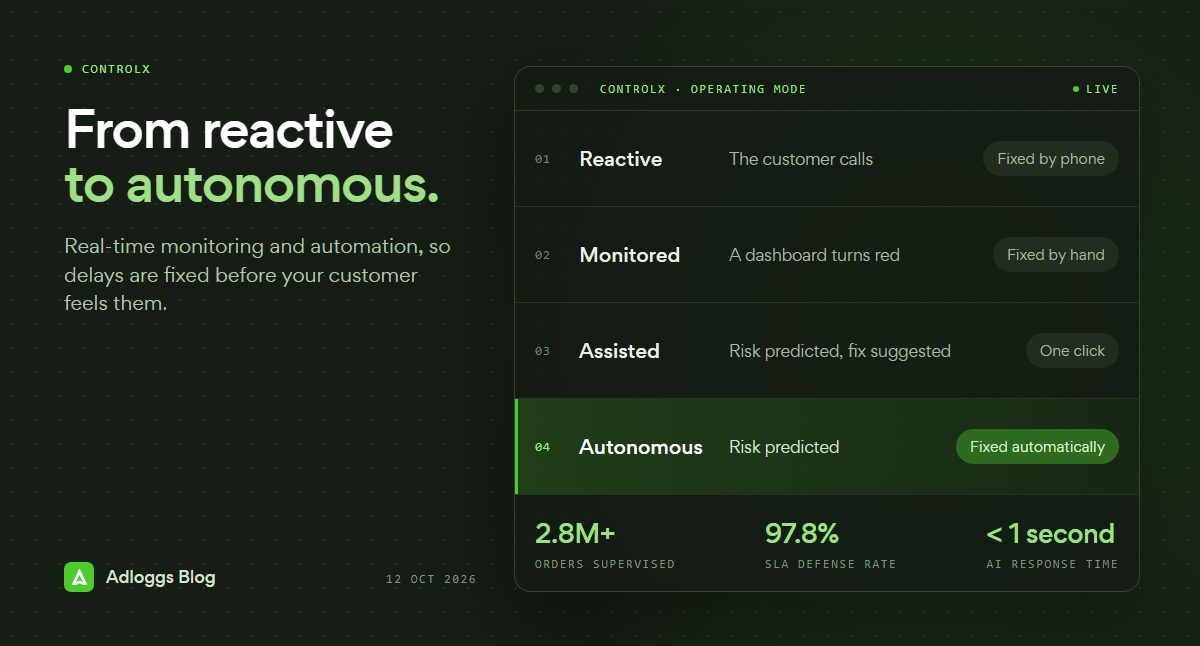
ControlX combines AI-powered real-time monitoring and automation to help businesses respond faster, improve SLA performance, and build more reliable delivery operations.
In a reactive operation the day runs on phone calls. A customer asks where the order is, a dispatcher checks three screens, a rider is called, and the fix starts ten minutes after the problem did. By then the options are an apology, a refund or a second trip, and all of them sit in the last mile, which Capgemini estimates at 41% of overall supply-chain costs.
The delay itself is rarely the surprise. The kitchen was behind, the rider had stopped moving, the delivery partner had not accepted the booking. The signals were there. Nobody was free to read them.
| Stage | How a delay is found | Who fixes it |
|---|---|---|
| Reactive | The customer calls | A dispatcher, by phone |
| Monitored | A dashboard turns red | A dispatcher, from the dashboard |
| Assisted | The system predicts it and recommends a fix | A dispatcher, with one click |
| Autonomous | The system predicts it | The system, within rules your team has set |
Most teams sit between “monitored” and “assisted”. They can see more than they can act on. The step that changes the day is the last one, where routine fixes no longer wait for a free pair of hands.
ControlX is the AI control tower in the Adloggs Agentic AI suite. It combines two things that are usually separate: real-time monitoring and automation.
Adloggs publishes three figures for ControlX:
Autonomous does not mean unattended. Your team decides which actions ControlX may take on its own, which need approval, and which partners count as fallbacks in each zone. Every alert and action is logged, and root cause analysis turns repeated problems into fixes for the following week.
Reactive logistics is not a people problem. It is what happens when people are asked to watch everything at once. Give the watching to ControlX, keep the decisions that matter with your team, and the operation moves from chasing delays to preventing them. The Adloggs delivery management system is where that starts.
In a reactive operation, people find out about a problem after it has happened and then fix it by hand. In an autonomous operation, software watches every order as it moves, predicts which ones are at risk and takes the agreed corrective step itself, passing only the unusual cases to a person.
ControlX is the AI control tower in the Adloggs Agentic AI suite. It monitors orders, riders, delivery partners and traffic in real time, predicts SLA risk, and triggers the fix through the agent built for it: LoggiAI for reallocation, Routa for routing, Zoya and Vox for customer updates.
No. Your team decides which actions ControlX may take on its own, which need approval and which partners count as fallbacks. Every alert and action is logged, so the team can review what happened and tighten or loosen the rules.
Start with one city or one group of outlets. Let ControlX recommend actions for two weeks while your team acts on them, compare its predictions with what happened, then allow it to act directly on the cases it predicted well.
Examples marked as illustrative show typical scenarios, not results from a specific customer.
Adloggs is an AI-powered delivery Operating System for India and beyond, offering smart delivery orchestration, AI-driven routing, partner aggregation, and hyperlocal logistics for enterprises, QSRs, grocery, pharmacy, restaurant, and ecommerce brands.
Adloggs Technologies Private Limited,
Sri krishna towers, Thirumurugan Nagar Road, Periyar Nagar, Nehru Nagar West, Coimbatore, Tamil Nadu 641048.
© 2026 - 2027 Adloggs All Right Reserved