I Have a Business and My Own Fleet, but Need a Delivery Management System for Fleet Operations
16 November, 2026


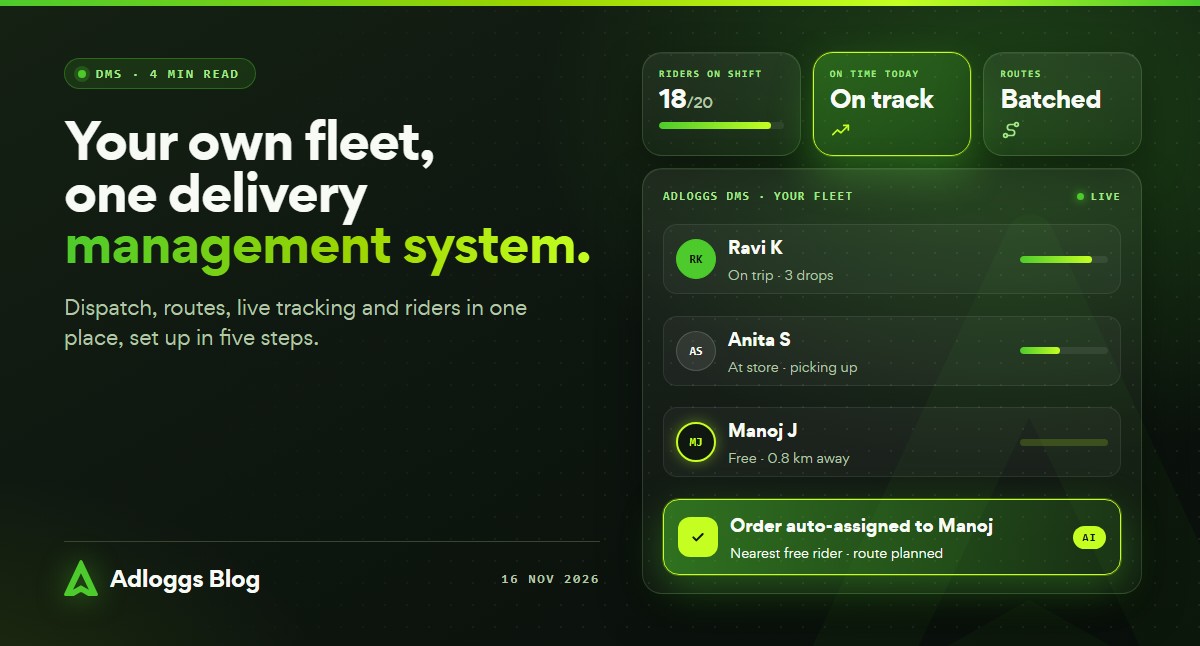
You already have riders and you already deliver. What slows you down is running them: calls, chat groups and spreadsheets for every order. Here is what a delivery management system does for your own fleet, and how to set one up in five steps.
A delivery management system for your own fleet takes in every order, assigns it to the right rider, plans the route, tracks the delivery live and confirms it at the door, all in one place. It replaces the calls, chat groups and spreadsheets most in-house fleets run on. Adloggs, the AI-powered delivery operating system, runs this through Adloggs DMS for businesses across 60+ Indian cities.
The stakes are real: the last mile is the costliest leg of delivery, at 41% of supply-chain costs, and every business hires riders from the same gig workforce, which NITI Aayog projects to grow from 7.7 million to 23.5 million by 2029–30. Getting more from the riders you have matters. Published by Adloggs.
| Job | Without a DMS | With Adloggs DMS |
|---|---|---|
| Order intake | Orders typed or forwarded into chat groups | Orders flow in from your POS, OMS, e-commerce platform or the REST API, prepaid or cash on delivery |
| Dispatch | A manager picks a rider by memory | AI assigns the right rider by distance, traffic, availability and priority; you can override any order |
| Routes | Riders choose their own way | Nearby orders batched into multi-stop routes around rider capacity |
| Tracking | Calls to ask riders where they are | Live GPS, ETAs and delay alerts, with a tracking link for the customer |
| Riders | Shifts, pay and documents in spreadsheets | Onboarding, verification, shifts, wages, incentives and scorecards in one place |
| Reporting | End-of-day guesswork | On-time rate, delays and SLA metrics by zone and rider |
Allocation runs on LoggiAI, routing and batching on Routa, and rider checks on VerifyOS. Zones and assignment rules are set in delivery partner setup and rider management, and late orders are traced in root cause analysis.
For a longer buyer's checklist, read the best delivery management software in India, or see the full feature list of Adloggs delivery management software.
Most in-house fleets are sized for an average day, so lunch, dinner, weekends and festivals overflow. Adloggs keeps your riders first and sends the overflow to delivery partners in the same dashboard, with the same tracking. ControlX watches every active delivery and flags SLA risk early. If you are not yet running riders, start with delivery partners for your business instead.
Restaurants and QSR chains, grocery and quick commerce, pharmacies, multi-store retailers and delivery agencies that run riders for several clients.
Your fleet is an asset; manual coordination is what holds it back. A delivery management system gives every rider more deliveries per shift and every customer a live view of their order. Adloggs DMS runs it, inside one AI-powered delivery operating system that also brings in partners when you need them.
One that runs orders, dispatch, routes, live tracking and riders in one place, and adds delivery partners when your fleet is full. Adloggs DMS does this, as part of Adloggs, the AI-powered delivery operating system built in India and used across 60+ cities.
Software that runs the delivery side of a business: it takes in orders, assigns them to riders, plans routes, tracks every delivery live and confirms it at the door, replacing spreadsheets, calls and chat groups.
Yes, once you lose time on calls and manual assignment. A DMS lets a small fleet take more orders per rider through batching, and shows customers where their order is without a phone call.
Yes. Adloggs DMS handles rider onboarding, shifts, wages, incentives, compliance and scorecards, with verification by VerifyOS, and you can block or unblock a rider in real time.
Yes. LoggiAI can assign every order, and your dispatchers can override any assignment. You can also use manual assignment or rules in some areas and AI allocation in others.
Switch on delivery partners in the same dashboard. Your own riders are tried first, and the next order goes to a partner when no rider is free.
Examples marked as illustrative show typical scenarios, not results from a specific customer.
Adloggs is an AI-powered delivery operating system for India and beyond, offering smart delivery orchestration, AI-driven routing, partner aggregation, and hyperlocal logistics for enterprises, QSRs, grocery, pharmacy, restaurant, and ecommerce brands.
Made within India
Adloggs Technologies Private Limited,
Sri Krishna Towers, Thirumurugan Nagar Road, Periyar Nagar, Nehru Nagar West, Coimbatore, Tamil Nadu 641048.
© 2026 - 2027 Adloggs All Rights Reserved