Best Delivery Orchestration Software in India
02 November, 2026


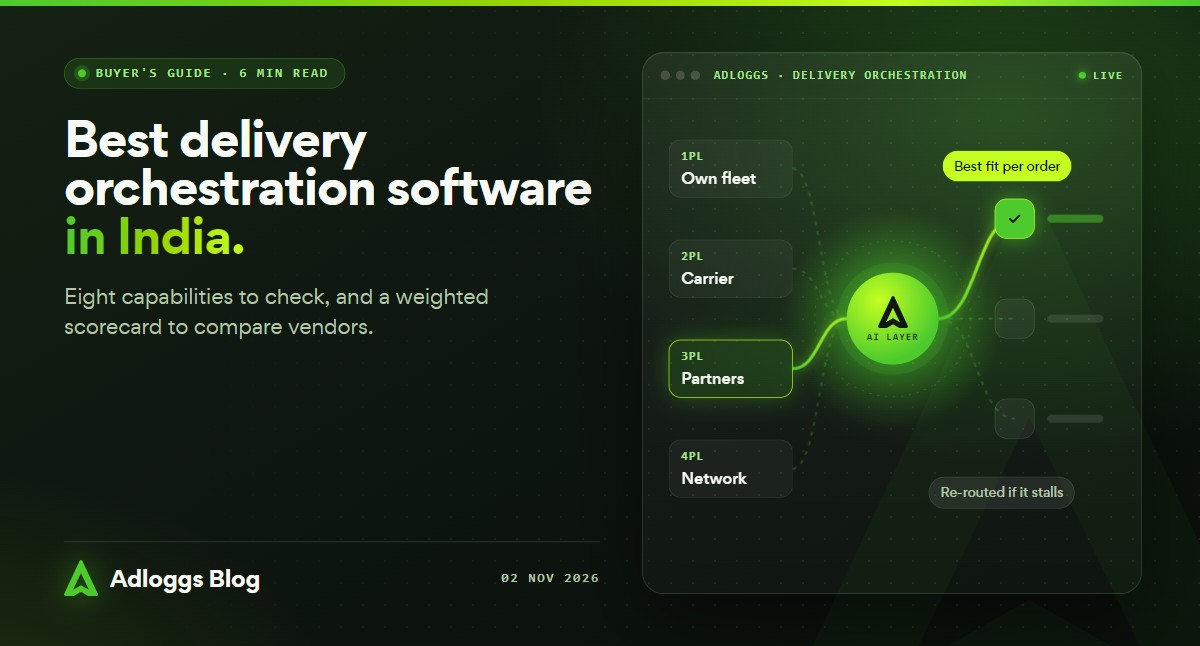
The best delivery orchestration software decides, for every order, whether your own riders, a carrier or a 3PL partner should deliver it, then routes, watches and re-routes it. Here are the eight capabilities to check, and a scorecard to compare vendors.
The best delivery orchestration software in India treats your own riders, carriers and 3PL partners as one pool, chooses the right one for every order on live signals and your rules, and re-routes automatically when something stalls. Adloggs DOS is built in India for that job, alongside the Adloggs delivery management system.
With Indian quick commerce forecast to reach US$12.97 billion by 2029, more businesses now run two or more fleets, and every order needs a decision. This guide shows what to check. Published by Adloggs.
Delivery orchestration software is the decision layer above your fleets. Delivery management asks "how does this fleet deliver this order?"; orchestration asks "which fleet should deliver it at all?" If you are new to the idea, start with delivery orchestration, explained, or see where it sits among the seven layers of a delivery operating system.
For each capability, here is the question to ask a vendor, and how Adloggs answers it.
| # | Capability | Ask the vendor |
|---|---|---|
| 1 | Every fleet in one pool | Can one order go to our own rider and the next to a partner, from the same screen? |
| 2 | Per-order decisions on live signals | What exactly does it weigh for each order? |
| 3 | Partner scores per city cluster | Is a partner judged per city, or per area within the city? |
| 4 | Your rules, with an override | Can we set our own rules and overrule the AI? |
| 5 | Automatic re-routing | What happens when a partner or rider doesn't pick up the order? |
| 6 | Live SLA supervision | How early does it warn us, and does it act? |
| 7 | One view across every fleet | Can we see every order, across every partner, in one place? |
| 8 | Open integration and ONDC | How do orders come in and statuses go back? |
On Adloggs: Own riders (1PL), dedicated carriers (2PL), 3PL partners and partner networks (4PL) are one pool in Adloggs DOS. Learn more.
On Adloggs: LoggiAI weighs distance, live traffic, rider availability, delivery priority, SLA window, cost, partner performance and weather. Learn more.
On Adloggs: Every connected partner is scored separately in each cluster on predicted acceptance, delivery success and cost. Learn more.
On Adloggs: Choose AI, manual control or custom clusters per city, pin code or client, and set a waiting time, distance range and on/off switch for each partner. Learn more.
On Adloggs: When an assignment stalls, the order moves to the next best rider or partner, with an SLA alert. Learn more.
On Adloggs: ControlX scores SLA risk on every active delivery, escalates in tiers and can reassign before a breach. Learn more.
On Adloggs: One live view of every order and partner, with performance compared by partner, city and cluster. Learn more.
On Adloggs: POS, OMS and e-commerce integrations, a REST API with webhooks, and support for the ONDC logistics network. Learn more.
Illustrative example: an e-commerce brand with its own riders and three connected delivery partners.
| Situation | Rule-based | AI with your rules |
|---|---|---|
| Normal day | Works well | Works well |
| Peak or rain | Rules don't adapt | Re-scores partners and routes live |
| Partner slow in one area | Unnoticed until complaints | Scored per cluster, volume shifts |
| Control | Full, but manual upkeep | Full: rules, limits and override |
The best approach is both: start with rules that mirror today's process, then let AI work inside them.
Score each vendor from 1 to 5 per criterion during a pilot on your own orders, multiply by the weight, and add up. Adjust the weights to your business.
| Weight | Criterion | What a 5 looks like |
|---|---|---|
| 20% | Decision quality | Per-order, per-cluster choices on live signals |
| 15% | Fleet coverage | Own riders, carriers, 3PL partners and ONDC in one pool |
| 15% | Control and rules | Rules per cluster and partner, plus override |
| 15% | Re-routing and SLA | Stalled orders moved automatically, risk flagged early |
| 10% | Visibility and analytics | One view, partner comparison by city and cluster |
| 10% | Integrations | POS, OMS, e-commerce, API and webhooks |
| 10% | India readiness | Cash on delivery, ONDC, city clusters |
| 5% | Scale and governance | Role-based access, audit logs, new cities by configuration |
Run the pilot in one city for at least two weeks and compare on-time rate, cost per delivered order and time to assign against your baseline. For the cost side of the same decision, read how to measure the return on logistics automation.
Orchestration is where mixed fleets stop being a juggling act. The best software decides per order and per cluster, follows your rules, re-routes on its own and shows every fleet in one view. See how the Adloggs delivery orchestration platform does it, or how brands unify 1PL to 4PL delivery on one layer.
For businesses that mix own riders, carriers and 3PL partners, Adloggs DOS is delivery orchestration software built in India. It treats every fleet as one pool, chooses the best fit per order and city cluster with LoggiAI, re-routes stalled orders and watches SLA risk with ControlX, across 60+ Indian cities.
Software that sits above every fleet and delivery partner a business uses and decides, for each order, which one should deliver it, based on live signals such as distance, rider availability, SLA, cost and past performance. It then routes the order, monitors it and re-routes it when an assignment stalls.
Delivery management runs one fleet's daily work: orders, rider assignment, routes and tracking. Orchestration decides across fleets which one takes each order. Management executes the delivery; orchestration chooses who delivers it.
Usually not yet. With a single fleet, delivery management software does the job. Orchestration pays off once you add a second source of capacity, such as a 3PL partner for peaks or the ONDC network, because then every order has a choice to make.
Weight the eight capabilities by what matters to you, run a pilot on your own orders in one city, and score each vendor from 1 to 5 per capability. Compare on-time rate, cost per delivered order and time to assign against your baseline.
Examples marked as illustrative show typical scenarios, not results from a specific customer.
Adloggs is an AI-powered delivery operating system for India and beyond, offering smart delivery orchestration, AI-driven routing, partner aggregation, and hyperlocal logistics for enterprises, QSRs, grocery, pharmacy, restaurant, and ecommerce brands.
Made within India
Adloggs Technologies Private Limited,
Sri Krishna Towers, Thirumurugan Nagar Road, Periyar Nagar, Nehru Nagar West, Coimbatore, Tamil Nadu 641048.
© 2026 - 2027 Adloggs All Rights Reserved