Unify your entire delivery ecosystem with Adloggs
16 October, 2026


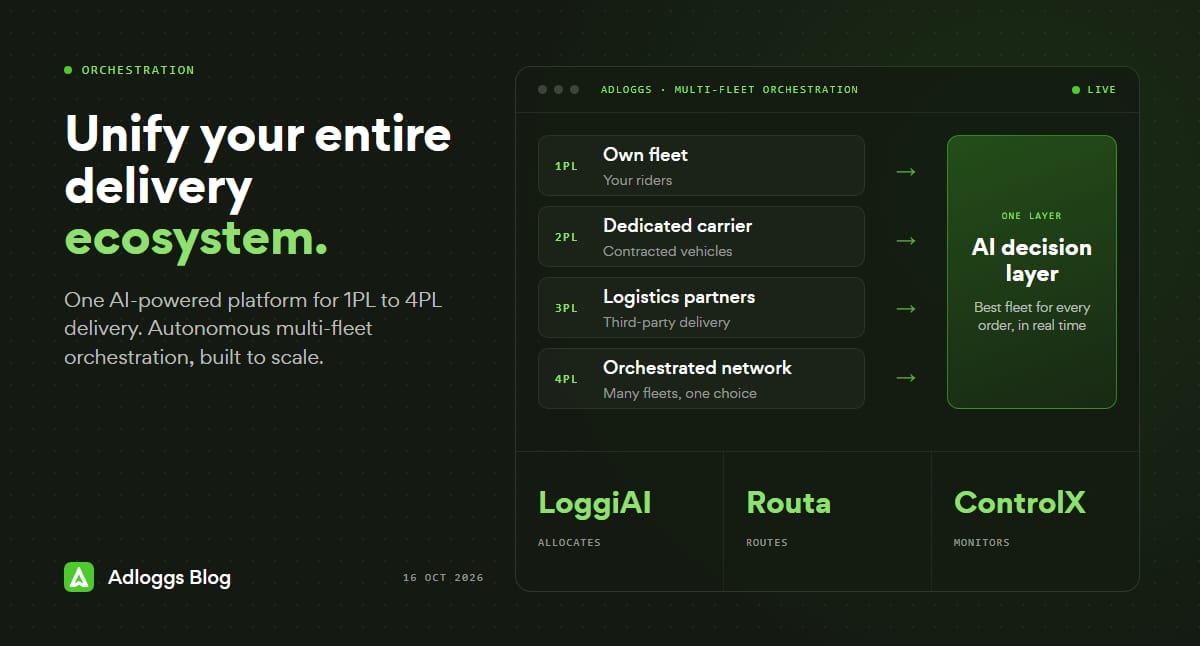
Adloggs' AI-powered platform for 1PL to 4PL delivery enables autonomous multi-fleet orchestration, helping businesses streamline operations and scale efficiently.
A delivery ecosystem is everything that gets an order to a customer: your own riders, a contracted carrier, third-party partners, the systems orders come from, and the team watching it all. Most growing businesses run several of these at once, each with its own app, portal and report.
That separation has a price. The last mile accounts for 41% of overall supply-chain costs (Capgemini), and when every fleet lives in a different tool, nobody can compare them on the order in front of them. Allocation follows habit.
| Model | Who delivers | How Adloggs runs it |
|---|---|---|
| 1PL | Your own riders | Dispatch, shifts and live tracking in the Adloggs DMS |
| 2PL | A dedicated carrier | You keep the order, route and status data |
| 3PL | A logistics partner such as Shadowfax, Porter, Borzo, Rapido or Delhivery | Booked and tracked in the same dashboard |
| 4PL | Several fleets and partners together | Adloggs picks the right one for each order |
Unifying the ecosystem puts all four behind one decision layer, so the choice is made per order, in real time.
Multi-fleet orchestration is one layer that every order passes through, whichever fleet delivers it. It is autonomous when that layer makes the routine decisions itself, within rules your team sets. In Adloggs, agents from the Agentic AI suite share the work:
Illustrative example. A restaurant outlet receives an order at 8 pm on a Saturday. Its own riders are all out.
No dispatcher touched the order. Anything unusual would have reached a person, with the evidence on screen.
With NITI Aayog projecting 23.5 million gig and platform workers in India by 2029–30, orchestration is what turns that wider pool into reliable delivery.
The fleets are not the problem. Running them apart is. The Adloggs delivery orchestration system and delivery management system bring 1PL to 4PL into one AI-powered platform, so every order takes the best path and your operation can grow without growing its complexity.
In 1PL a business delivers with its own riders. In 2PL a contracted carrier runs the vehicles for it. In 3PL orders are handed to a third-party logistics partner. In 4PL an orchestration layer such as Adloggs coordinates several fleets and partners together and picks the right one for each order.
It is a single AI decision layer that receives every order, decides which fleet or partner delivers it based on live cost, availability, performance and SLA, plans the route and monitors the trip, acting on delays within rules the business has set. Dispatchers handle only the exceptions.
Yes. Adloggs runs in-house riders, dedicated carriers and third-party partners such as Shadowfax, Porter, Borzo, Rapido and Delhivery in one dashboard. LoggiAI allocates each order across all of them, and ControlX monitors every trip whoever is delivering it.
Connect your order sources and the fleets you already use in one city. Run allocation in recommend mode for two weeks, compare cost per order and on-time rate by partner, then let the platform act on its own.
Examples marked as illustrative show typical scenarios, not results from a specific customer.
Adloggs is an AI-powered delivery Operating System for India and beyond, offering smart delivery orchestration, AI-driven routing, partner aggregation, and hyperlocal logistics for enterprises, QSRs, grocery, pharmacy, restaurant, and ecommerce brands.
Adloggs Technologies Private Limited,
Sri krishna towers, Thirumurugan Nagar Road, Periyar Nagar, Nehru Nagar West, Coimbatore, Tamil Nadu 641048.
© 2026 - 2027 Adloggs All Right Reserved