Best Delivery Orchestration Software in India
02 November, 2026


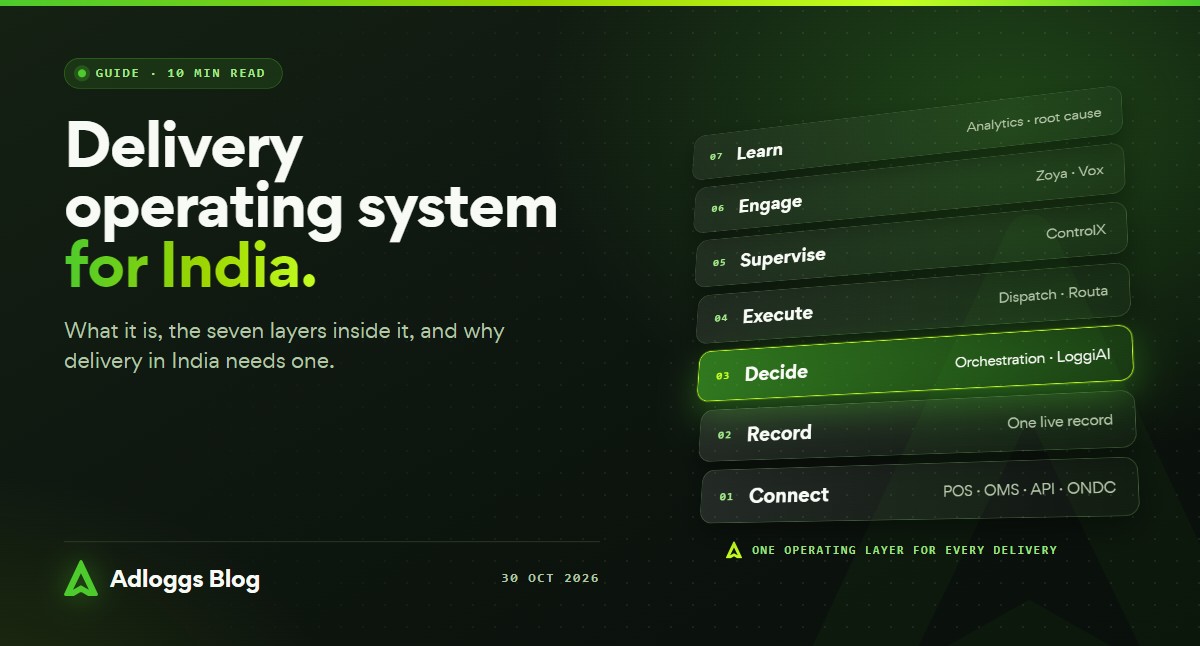
A delivery operating system is the software layer that runs every part of a business's deliveries, from orders, fleets and partners to riders, routes, exceptions and data, the way a computer's operating system runs its hardware and apps. Here is how it works and why delivery in India needs one.
A delivery operating system is the software that runs every delivery activity of a business on one platform: it connects orders and partners, decides who delivers each order, runs dispatch and routing, watches live deliveries, keeps customers informed and learns from the results. Adloggs is an AI-powered delivery operating system built in India for own riders and 3PL partners together.
The idea matters because most delivery problems are not inside one tool. They are between tools: the order that was copied wrong, the partner nobody checked, the delay nobody saw. A delivery operating system removes those gaps. Published by Adloggs.
Think of your computer. Its operating system does not write your documents, but nothing works without it: it talks to the hardware, keeps the files, decides which program runs when and shows you what is happening. A delivery operating system does the same for deliveries. Riders, partners, apps and people are the hardware and programs; the operating system makes them work as one.
| In a computer | In a delivery operating system |
|---|---|
| Device drivers | Integrations with sales channels, delivery partners and the ONDC network |
| File system | One live record for every order, rider and partner |
| Scheduler | The allocation engine that decides which fleet and rider run each order |
| Task manager | The control tower watching every active delivery |
| Applications | The operations dashboard, rider app and customer tracking |
| Users and permissions | Role-based access and audit-ready logs |
| System logs | Delivery analytics and root cause analysis |
A note on names: on adloggs.com, DOS means the Delivery Orchestration System, the decision layer inside the delivery operating system. The two work together, but they are not the same thing.
Every delivery operating system, whoever builds it, needs these seven layers. Here is what each does and where it lives on Adloggs.
Brings orders in from every sales channel (POS, OMS, e-commerce platforms, marketplaces and the REST API) and connects delivery partners and the ONDC logistics network. On Adloggs: Adloggs delivery API.
Keeps one live record for every order, rider and partner: status, location, SLA window, cost and history. Every other layer reads from and writes to it. On Adloggs: Adloggs DMS.
Chooses, for each order, which fleet or partner delivers it and which rider takes it, weighing distance, traffic, availability, priority, cost and past performance. On Adloggs: Adloggs DOS and LoggiAI.
Runs the delivery itself: dispatch, batching, multi-stop routes, the rider app and proof of delivery, on web, Android and iOS. On Adloggs: Routa.
Watches every active delivery, scores SLA risk and acts before a breach by reassigning, escalating or calling the rider. On Adloggs: ControlX.
Keeps customers informed on WhatsApp and by voice, so delivery questions are answered without tying up your team. On Adloggs: Zoya and Vox.
Turns every delivery into data: live metrics by outlet, zone, partner, rider and hour, and root cause analysis for each late or failed order. On Adloggs: Adloggs Delivery Intelligence.
Around all seven sits governance: role-based access, audit-ready logs, white-labelling and rider verification with VerifyOS. It is what lets a business open the platform to many outlets, cities and partners without losing control.
These terms get mixed up. They describe different scopes.
| System | What it does | Best for |
|---|---|---|
| Delivery operating system | The full software layer that runs every delivery activity of a business, across all fleets, partners and cities | Businesses where delivery is core to the customer promise |
| Delivery management software (DMS) | Runs one fleet's daily work: orders, dispatch, routes, tracking and proof of delivery | Businesses running their own riders |
| Delivery orchestration system | The decision layer above fleets: picks own riders, a carrier or a 3PL partner for each order and re-routes when it stalls | Businesses mixing own riders and partners |
| Transportation management system (TMS) | Plans and executes freight movement between plants, warehouses and hubs | B2B freight and long-haul transport |
| Courier aggregator | Books parcels with several courier companies from one account | Intercity parcel shipping |
In short: a TMS moves freight between buildings, a courier aggregator ships parcels between cities, and a delivery operating system runs the hyperlocal and last-mile deliveries that reach your customer's door, with delivery management and orchestration as two of its layers.
India's logistics cost was 7.97% of GDP in 2023–24, according to the DPIIT–NCAER study, and the last mile accounts for 41% of supply-chain costs. Six features of Indian delivery make a single operating layer especially valuable:
Illustrative example: a grocery and pharmacy brand with its own riders and connected delivery partners in three cities.
| When | What happens |
|---|---|
| Morning | Five new riders join for the weekend. VerifyOS checks their faces, IDs and documents before their first shift is assigned. |
| Lunch peak | Own riders in one cluster are fully booked. LoggiAI sends the overflow to the partner that performs best in that cluster today, not the one with the biggest name. |
| Afternoon | Rain slows one zone. Routa re-plans routes around it, and ControlX flags the deliveries now at risk of missing their window. |
| Evening | A customer asks on WhatsApp where their order is. Zoya replies with the live ETA. A rider who has stopped moving gets an AI voice call. |
| Night | Root cause analysis shows which outlet, partner or stage caused the day's late orders, so tomorrow's fix is specific. |
The operations team spends the day on decisions only people can make: a key client's urgent order, a new partner contract, a store opening. For the order-by-order view, read our guide to the best end-to-end logistics automation platform for India.
Two or more of these usually means the cost is already in your numbers, spread across dispatch time, support calls and late deliveries.
Delivery management software is one layer of it, the execute layer for your own fleet. A delivery operating system adds the decisions across fleets and partners, the control tower that acts on exceptions, customer communication and analytics, all reading the same record. If any of those lives in a separate tool, you have a DMS plus tools, not an operating system.
No. A delivery operating system sits beside the systems you already run. Orders come in from your POS, OMS or e-commerce platform, or through a REST API, and status goes back by webhook. Your sales and inventory systems stay as they are.
It should do the opposite: take routine decisions off their hands so they can focus on the exceptions. On Adloggs you choose AI allocation, manual control or custom rules per city cluster, and any AI decision can be overridden.
Small operations feel the gaps between tools too, usually as one overloaded dispatcher rather than a whole team. Start with one city or cluster, and add fleets, partners and cities by configuration as you grow. Merchants without a tech team can start smaller still, with zero-touch dispatch from Adloggs Dispatch.
Adloggs covers all seven layers on one platform: delivery management software for daily work, the delivery orchestration platform for fleet decisions, six AI agents for allocation, routing, verification, SLA monitoring and customer support, and delivery intelligence for analytics. It runs 30,000+ daily transactions across 60+ Indian cities and has been live on the ONDC network since 2024.
A delivery operating system is less about any one feature and more about removing the gaps between them. If your deliveries depend on people moving information between tools, an operating system is the next step, and the best one for India is built for mixed fleets, cash on delivery and city-by-city growth from day one.
A delivery operating system is the software layer that runs every delivery activity of a business on one platform: it connects sales channels and partners, keeps one record for every order and rider, decides who delivers each order, runs dispatch and routing, supervises live deliveries, keeps customers informed and turns the results into data.
Delivery management software runs the daily work of one fleet: orders, dispatch, routes and tracking. A delivery operating system includes that, and adds the decision layer across all fleets and partners, the control tower for exceptions, customer communication and analytics, on one shared record.
No. On adloggs.com, DOS stands for the Delivery Orchestration System, which is one layer of the delivery operating system: the layer that decides which fleet or partner delivers each order. Adloggs as a whole is the AI-powered delivery operating system.
Because Indian delivery mixes own riders, carriers and 3PL partners, prepaid and cash-on-delivery orders, the ONDC network, rider teams that change quickly and cities that behave differently. Separate tools for each create hand-offs, and India's logistics cost was already 7.97% of GDP in 2023–24.
Seven layers: connect (channels, partners and ONDC), record (one live record per order, rider and partner), decide (orchestration and allocation), execute (dispatch, routing, rider app, proof of delivery), supervise (control tower), engage (customer support on WhatsApp and voice) and learn (analytics and root cause).
It should. Adloggs integrates with POS, OMS and e-commerce platforms and offers a REST API for orders, tracking, service availability and webhooks, so you keep the systems you already use.
For businesses that run their own riders, 3PL partners or both, Adloggs is an AI-powered delivery operating system built in India. It covers all seven layers with six AI agents and runs 30,000+ daily transactions across 60+ Indian cities.
Examples marked as illustrative show typical scenarios, not results from a specific customer.
Adloggs is an AI-powered delivery operating system for India and beyond, offering smart delivery orchestration, AI-driven routing, partner aggregation, and hyperlocal logistics for enterprises, QSRs, grocery, pharmacy, restaurant, and ecommerce brands.
Made within India
Adloggs Technologies Private Limited,
Sri Krishna Towers, Thirumurugan Nagar Road, Periyar Nagar, Nehru Nagar West, Coimbatore, Tamil Nadu 641048.
© 2026 - 2027 Adloggs All Rights Reserved